

Why Some SEO, AEO, LLM, GEO, and AIO Practices Fail – and How to Fix Them

Why SEO, AEO, LLM, GEO and AIO Work Fails, and How to Fix It

Table of Contents

Introduction

Most SEO, AEO, LLM, GEO and AIO work fails for one reason. The business buys tactics before it builds the foundation those tactics stand on. All five draw on the same base, which is a fast, well-ordered site, content that answers real questions in quotable sentences, claims backed by proof, and a brand named the same way everywhere a machine might look. Break that base and all five fail at once. Below are the nine places visibility leaks, the fix for each, and a 30-day plan you can run yourself.

You publish every week. The report says impressions are up. The tracker shows a few green arrows. The phone still doesn’t ring, the form stays empty, and when you type your own service into ChatGPT, a competitor comes back.

We have this conversation with business owners most weeks. The effort is nearly always real. What goes wrong is that five labels get bought as five separate jobs, and nobody checks what each label is meant to win.

Key Takeaways

  • SEO, AEO, LLM optimisation, GEO and AIO aren’t five services. They’re five results of one well-built foundation.
  • Question-first content now beats keyword-first content. Semrush clocked conversational AI prompts at 23 words on average, against 4.2 words for a typed search.
  • If a sentence needs its paragraph to make sense, AI won’t quote it. Self-contained sentences are the fastest win on this list.
  • Schema is close to mandatory. Schema that argues with your page or your Google Business Profile does active harm.
  • Rankings are the wrong scoreboard. Track AI citations, AI referral traffic, branded search and enquiry quality instead.
  • Clicks drop when an AI Overview sits above you. Pew Research logged a link click on 8% of visits with an AI summary, against 15% without one.
  • Fix the foundation before you buy the next tactic. The 30-day plan is at the end of this guide.

What the five acronyms actually mean
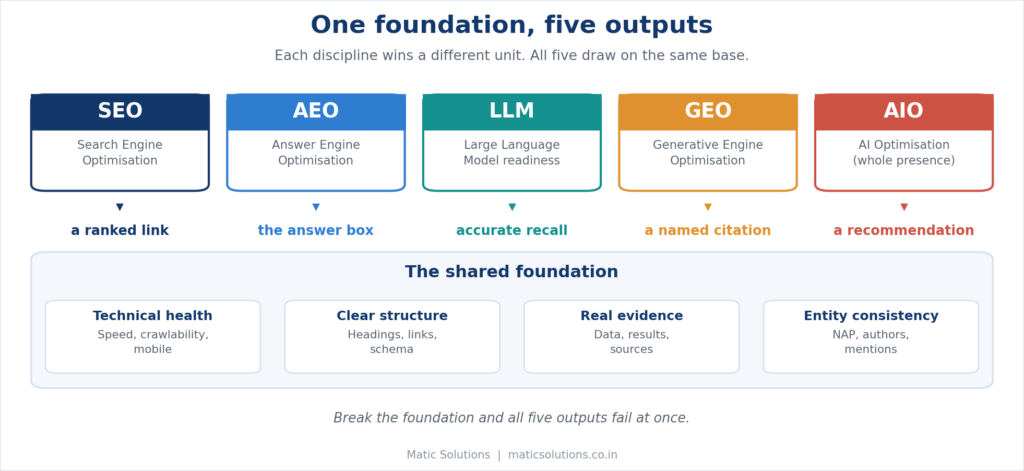
seo-aeo-geo-aio-one-foundation

SEO (Search Engine Optimisation). You optimise to rank as a blue link in ordinary search results. The win is a click to your site.

AEO (Answer Engine Optimisation). You optimise to be the answer inside featured snippets, People Also Ask boxes and voice results. Often nobody clicks, and your brand still takes the credit.

LLM optimisation. You make your content easy for large language models to read, understand and repeat correctly when someone asks about your category.

GEO (Generative Engine Optimisation). You optimise to be named inside an AI answer, including Google’s AI Overviews and AI Mode.

AIO (AI Optimisation). You shape your whole digital presence so AI systems can recommend you with confidence.

How the five compare at a glance

Discipline Unit of success What you optimise Where it shows up How you measure it
SEO A ranked URL Relevance, authority, technical health Blue links, Maps Position, organic clicks
AEO An extracted answer Question headings, 40 to 60 word answers, FAQ schema Snippets, PAA, voice Snippet ownership, impressions
LLM
optimisation
Accurate brand recall Self-contained sentences, consistent terminology ChatGPT, Claude, Gemini replies Prompt testing accuracy
GEO A named citation Original data, sources, third-party corroboration AI Overviews, Perplexity Citation share of voice
AIO A confident recommendation All of the above plus off-site consistency Everywhere Branded search, AI referrals

Quick Takeaway.

Ask any agency that quotes you separately for SEO, AEO and GEO what actually differs in the work. The honest answer is usually the same foundation, packaged three times.

Where visibility actually leaks

Visibility doesn’t drain away in one place. It leaks at nine points between a customer’s question and your enquiry form. Seeing the whole run helps you fix them in the right order.
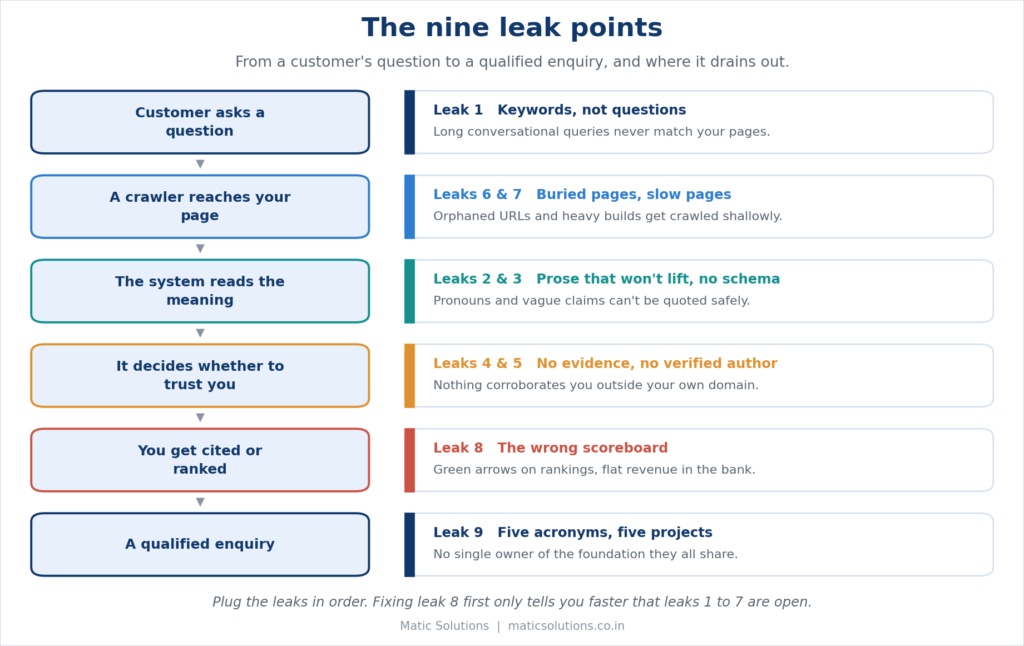
Nine leak points between a customer's question and a qualified enquiry

1. You chase keywords while buyers ask questions

What it looks like. You hold page one for “web design Ahmedabad” and traffic still falls. Impressions climb. Clicks drop.

Why it fails. People now type whole questions. Someone asks which web design company in Ahmedabad works with manufacturing exporters. Semrush measured conversational ChatGPT prompts at an average of 23 words, against 4.2 words once the search tool kicks in. Keyword-first pages are built for the short format, and the short format is shrinking. When an AI Overview sits above your listing, it takes the click you used to get.

How to fix it.

  • Pull real question data from People Also Ask, sales calls, WhatsApp enquiries and Search Console queries of four words or more.
  • Build one H2 per real question, worded the way a customer says it out loud.
  • Answer it in full inside the first 40 to 60 words under that heading.
  • Then expand. The detail is for people. The first two sentences are for machines.

Measure it.

Track the share of four-word-plus queries in Search Console month on month. A rising share means you’re matching how people now search.

2. Your sentences can't survive being pulled off the page

What it looks like. The writing reads beautifully and never gets quoted anywhere.

Why it fails. Answer engines and LLMs lift passages, not pages. A line like “it usually takes about three months to show results” is useless once it leaves its paragraph. Nothing in it says what “it” stands for, or which results are meant. A system that can’t resolve the reference skips the line and quotes a competitor who wrote it plainly.
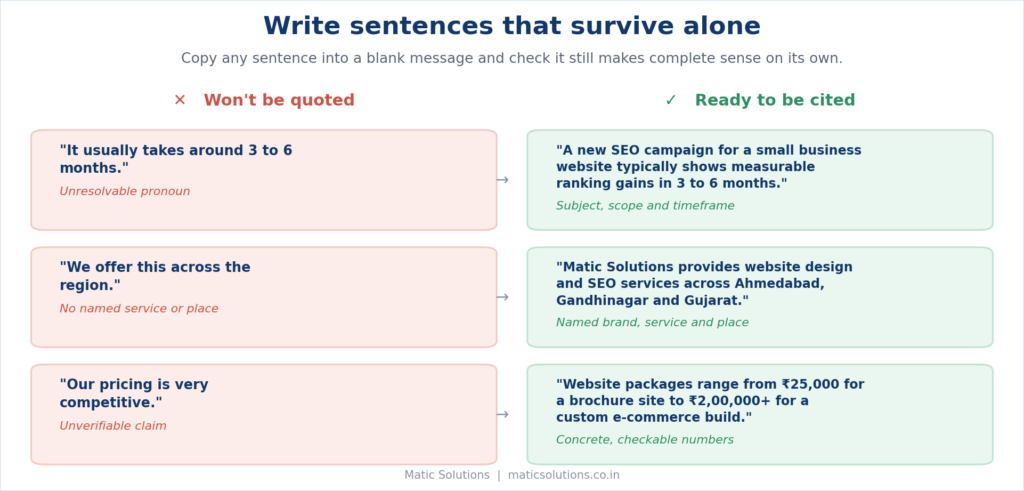
Unextractable prose against self-contained sentences AI systems can safely quote

Do this today.

Take five sentences off your most important service page and read each one alone. Every one that fails is a citation you’re handing to someone else.

3. No schema, or schema that argues with the page

What it looks like. A competitor gets FAQ dropdowns and star ratings in the results. You get a plain blue link.

Why it fails. Structured data is the most direct way to tell a machine what a page holds. Without it, crawlers and AI systems infer everything from prose, and they stay cautious, quoting only what they’re sure of. Plenty of sites that do have schema have it wrong. FAQ markup lists questions that never appear on the page. A LocalBusiness block carries an address the Google Business Profile doesn’t match. Markup that contradicts the page costs you trust.

How to fix it. At a minimum, add these types.

  • Organization and LocalBusiness on the home page, with NAP details identical to your Google Business Profile, character for character
  • Service schema on every service page
  • FAQPage wherever real questions and answers are visible to users
  • Article plus Person author markup on every blog post
  • BreadcrumbList across the whole site

Measure it. Run every page template through Google’s Rich Results Test and watch the Enhancements report in Search Console for errors. Our technical SEO checklist covers the rest of the crawl-side work.

4. You publish volume where evidence is needed

What it looks like. Forty posts a year. None cited, none ranking, most of them 1,500 words of common knowledge in new clothes.

Why it fails. Length was never a ranking factor. It stood in for depth, and that stopped working the moment AI made long text free to produce. What quality systems and LLMs reward now is information gain, meaning the page holds something the index doesn’t already have. A post that restates ten other posts adds nothing, at any word count.

How to fix it.

  • Put at least one thing only you can supply in every post. A client result, a real price range, a dashboard screenshot, a process you actually follow, a mistake you actually made.
  • Cite sources for factual claims and link the primary source, not a blog quoting it.
  • Delete or merge thin posts rather than letting them drag the whole site down.

Publish less often, and publish work that couldn’t exist without you.

5. Nobody outside your website can verify you

What it looks like. Your content is genuinely good and AI systems still recommend the competitor.

Why it fails. AI systems recommend entities they can check, which is what E-E-A-T is really measuring. If your business name appears in a consistent form only on your own domain, nothing corroborates it. An “Admin” byline on a post about SEO strategy carries no experience signal at all.

How to fix it.

  • Give every post a named author with a bio, a photo, a credential and a LinkedIn link.
  • Keep your name, address and phone number byte-identical across your website, Google Business Profile, Justdial, IndiaMART, LinkedIn and every directory you appear in. Our local SEO guide lists the ones that matter in India.
  • Chase third-party mentions in industry press, podcasts, local business media and guest columns. Even unlinked brand mentions count as corroboration.
  • Write an About page that reads like an encyclopaedia entry. Founded when, by whom, where, and serving which industries.

Quick takeaway.

Failures 4 and 5 are what separate “ranks sometimes” from “gets recommended by name”.

6. Your site structure makes sense only to its builder

What it looks like. Pages exist, but three clicks deep, orphaned, or duplicated across near-identical URLs.

Why it fails. Crawlers and AI agents map relationships through internal links. If your SEO page doesn’t link to your web development page, and your post on SEO mistakes links to neither, you’ve built six one-page sites instead of one site with authority.

How to fix it. Build topic hubs. One pillar page per service, every related post linking up to it, and the pillar linking back down. Use anchor text that says what it points at, such as SEO services in Ahmedabad, rather than “click here”. Keep every page that earns money within two clicks of the home page. Keep the XML sitemap clean and fix orphans as you find them. If you’re rebuilding anyway, design this into the website structure from the start rather than patching it later.

7. You treat speed and mobile as the developer's problem

What it looks like. Rankings improve, then slip quietly. Mobile bounce rate stays high.

Why it fails. Slow, unstable pages lose people before the content is read, and weak engagement feeds straight back into ranking. AI crawlers work to time budgets too. Heavy, render-blocking pages get crawled less thoroughly.

How to fix it. Target LCP under 2.5 seconds, INP under 200ms and CLS under 0.1. Serve images as WebP with width and height set so the layout can’t shift. Cut unused plugin CSS and JavaScript, which is usually the single biggest win on a WordPress build. Then test on a mid-range Android phone on 4G, not on office WiFi on a MacBook.

There is more detail in our guides to Core Web Vitals and to building a responsive, mobile-friendly website.

8. You measure rankings while the game moved to citations

What it looks like. Green arrows in the report. Flat revenue in the bank.

Why it fails. Position tracking was built for a ten-blue-links world. Pew Research found people clicked a traditional search result on 8% of visits where an AI summary appeared, against 15% of visits without one. A page-one listing under an AI Overview now earns a fraction of what it did two years ago, while the brand named inside that overview gets the consideration.
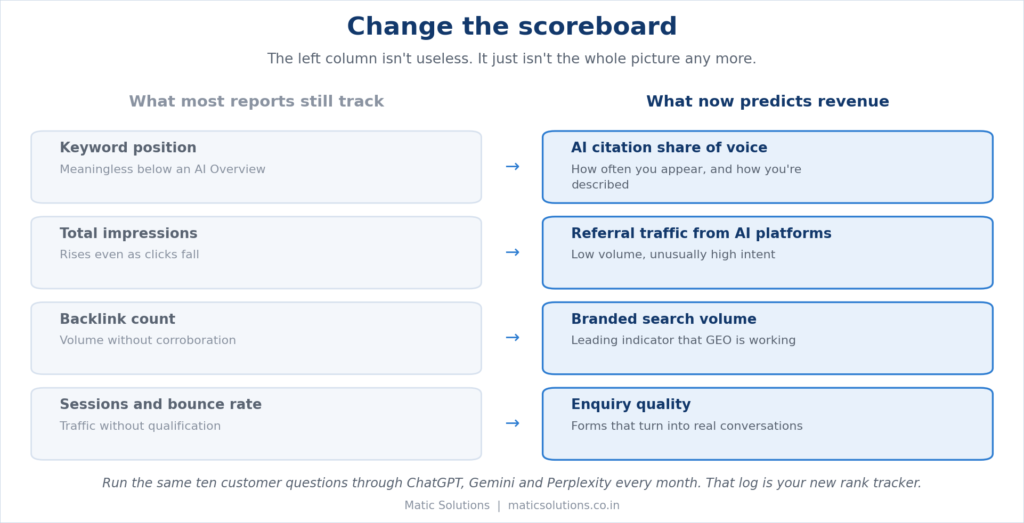
The metrics still being reported against the ones that now predict revenue
Traditional metric Why it's now incomplete Track this instead Where to get it
Keyword position A number one below an AI Overview loses most of its clicks AI citation share of voice Monthly manual prompt log
Impressions Inflates while clicks fall Click-through rate by query type Search Console
Backlinks Counts links, not corroboration Unlinked brand mentions Brand monitoring alerts
Sessions Doesn't distinguish intent AI-platform referral sessions GA4 segment for chatgpt.com,
perplexity.ai,
gemini.google.com
Bounce rate Noisy on informational pages Qualified enquiries per month CRM or form tagging

Measure it.

Semrush values the average AI search visitor at 4.4 times an ordinary organic visit, so small AI referral numbers deserve close attention rather than a shrug. Set the segments up in GA4 before you need them.

9. You buy five acronyms instead of one strategy

This failure sits underneath the other eight. When an agency quotes you separately for SEO, AEO and GEO, ask what specifically differs in the work. The honest answer is usually the same content and technical foundation, packaged three times.

One foundation. Five expressions of it. Anyone selling it another way is selling the packaging. If you want the ranking-side detail, our guide to the new ranking factors for 2026 goes deeper on the search half of this.

A 30-day fix plan you can actually run
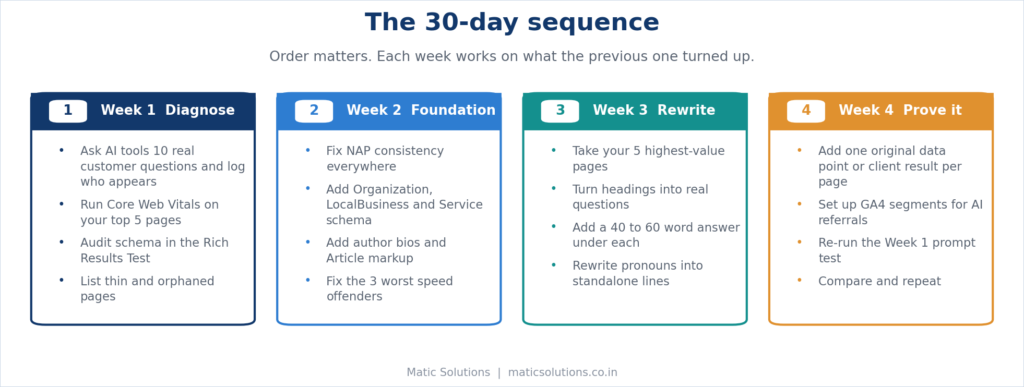
A four-week sequence that plugs the leaks in the right order

Week 1, diagnose. Ask ChatGPT, Gemini and Perplexity ten real customer questions and log who appears. Run Core Web Vitals on your top five pages. Audit schema in the Rich Results Test. List every thin and orphaned page, using our SEO audit checklist as the running order.

Week 2, foundation. Fix NAP consistency everywhere. Add Organization, LocalBusiness and Service schema. Add author bios and Article markup. Fix the three worst speed offenders.

Week 3, rewrite. Take your five highest-value pages. Turn headings into real questions. Add a 40 to 60 word direct answer under each. Rewrite pronouns into sentences that stand alone.

Week 4, prove it. Add one original data point or client result per page. Set up GA4 segments for AI referrals. Re-run the Week 1 prompt test and compare.

Order matters here. Each week works on what the previous one turned up. Fixing the reporting first only tells you faster that the other eight leaks are still open.

Conclusion

These practices don’t fail because the acronyms are wrong. They fail because businesses buy tactics before building what those tactics depend on, which is a fast and well-structured site, content that answers real questions in quotable sentences, claims backed by evidence, and a brand identity that stays consistent everywhere a machine might check. The SEO mistakes that quietly kill traffic nearly always trace back to one of those four.

Get that right and SEO, AEO, LLM optimisation, GEO and AIO stop being five problems. They become five results.

Get an honest audit instead of a report full of green arrows

Matic Solutions has built websites and search strategies for businesses. We'll show you where your visibility is breaking and what it takes to fix it.

Talk to our team

Frequently Asked Questions

SEO optimises your website to rank as a clickable link in ordinary search results. GEO, or Generative Engine Optimisation, optimises your content and brand presence so AI systems such as ChatGPT, Gemini and Google AI Overviews name you inside their answers. SEO earns a position. GEO earns a mention.

No. GEO builds on SEO rather than replacing it. AI systems still lean heavily on crawled and indexed web content, so a fast, well-linked, credible website remains the entry ticket for appearing in AI answers at all.

The usual causes are an AI Overview absorbing the click above your listing, rankings sitting on informational rather than commercial keywords, weak title tags that lose the click, and slow mobile performance that loses the visitor before the page loads.

Structural fixes such as schema and self-contained answer formatting can move featured snippets within four to eight weeks. Citation frequency inside AI answers usually takes three to six months, because it depends on model refresh cycles and on other websites corroborating your brand.

Ask ChatGPT, Gemini, Perplexity and Google AI Mode the questions your customers ask, without naming your brand. Record whether you appear and how you get described. Repeat monthly and track the change.
Author Bio

Matic Solutions

Matic Solution is a leading web development & Digital Marketing Agency in Ahmedabad. We offer top-notch Website Design and Development, SMM, SEO, PPC, Logo Design, Mobile App Development, and Website Domain and Hosting services. The goal of our business is to help you reach your full potential by improving your business.

Introduction

Most SEO, AEO, LLM, GEO and AIO work fails for one reason. The business buys tactics before it builds the foundation those tactics stand on. All five draw on the same base, which is a fast, well-ordered site, content that answers real questions in quotable sentences, claims backed by proof, and a brand named the same way everywhere a machine might look. Break that base and all five fail at once. Below are the nine places visibility leaks, the fix for each, and a 30-day plan you can run yourself.

You publish every week. The report says impressions are up. The tracker shows a few green arrows. The phone still doesn’t ring, the form stays empty, and when you type your own service into ChatGPT, a competitor comes back.

We have this conversation with business owners most weeks. The effort is nearly always real. What goes wrong is that five labels get bought as five separate jobs, and nobody checks what each label is meant to win.

Key Takeaways

  • SEO, AEO, LLM optimisation, GEO and AIO aren’t five services. They’re five results of one well-built foundation.
  • Question-first content now beats keyword-first content. Semrush clocked conversational AI prompts at 23 words on average, against 4.2 words for a typed search.
  • If a sentence needs its paragraph to make sense, AI won’t quote it. Self-contained sentences are the fastest win on this list.
  • Schema is close to mandatory. Schema that argues with your page or your Google Business Profile does active harm.
  • Rankings are the wrong scoreboard. Track AI citations, AI referral traffic, branded search and enquiry quality instead.
  • Clicks drop when an AI Overview sits above you. Pew Research logged a link click on 8% of visits with an AI summary, against 15% without one.
  • Fix the foundation before you buy the next tactic. The 30-day plan is at the end of this guide.

What the five acronyms actually mean

seo-aeo-geo-aio-one-foundation

SEO (Search Engine Optimisation). You optimise to rank as a blue link in ordinary search results. The win is a click to your site.

AEO (Answer Engine Optimisation). You optimise to be the answer inside featured snippets, People Also Ask boxes and voice results. Often nobody clicks, and your brand still takes the credit.

LLM optimisation. You make your content easy for large language models to read, understand and repeat correctly when someone asks about your category.

GEO (Generative Engine Optimisation). You optimise to be named inside an AI answer, including Google’s AI Overviews and AI Mode.

AIO (AI Optimisation). You shape your whole digital presence so AI systems can recommend you with confidence.

How the five compare at a glance

Discipline Unit of success What you optimise Where it shows up How you measure it
SEO A ranked URL Relevance, authority, technical health Blue links, Maps Position, organic clicks
AEO An extracted answer Question headings, 40 to 60 word answers, FAQ schema Snippets, PAA, voice Snippet ownership, impressions
LLM
optimisation
Accurate brand recall Self-contained sentences, consistent terminology ChatGPT, Claude, Gemini replies Prompt testing accuracy
GEO A named citation Original data, sources, third-party corroboration AI Overviews, Perplexity Citation share of voice
AIO A confident recommendation All of the above plus off-site consistency Everywhere Branded search, AI referrals

Quick Takeaway.

Ask any agency that quotes you separately for SEO, AEO and GEO what actually differs in the work. The honest answer is usually the same foundation, packaged three times.

Where visibility actually leaks

Visibility doesn’t drain away in one place. It leaks at nine points between a customer’s question and your enquiry form. Seeing the whole run helps you fix them in the right order.

Nine leak points between a customer's question and a qualified enquiry

1. You chase keywords while buyers ask questions

What it looks like. You hold page one for “web design Ahmedabad” and traffic still falls. Impressions climb. Clicks drop.

Why it fails. People now type whole questions. Someone asks which web design company in Ahmedabad works with manufacturing exporters. Semrush measured conversational ChatGPT prompts at an average of 23 words, against 4.2 words once the search tool kicks in. Keyword-first pages are built for the short format, and the short format is shrinking. When an AI Overview sits above your listing, it takes the click you used to get.

How to fix it.

  • Pull real question data from People Also Ask, sales calls, WhatsApp enquiries and Search Console queries of four words or more.
  • Build one H2 per real question, worded the way a customer says it out loud.
  • Answer it in full inside the first 40 to 60 words under that heading.
  • Then expand. The detail is for people. The first two sentences are for machines.

Measure it.

Track the share of four-word-plus queries in Search Console month on month. A rising share means you’re matching how people now search.

2. Your sentences can't survive being pulled off the page

What it looks like. The writing reads beautifully and never gets quoted anywhere.

Why it fails. Answer engines and LLMs lift passages, not pages. A line like “it usually takes about three months to show results” is useless once it leaves its paragraph. Nothing in it says what “it” stands for, or which results are meant. A system that can’t resolve the reference skips the line and quotes a competitor who wrote it plainly.

Unextractable prose against self-contained sentences AI systems can safely quote

Do this today.

Take five sentences off your most important service page and read each one alone. Every one that fails is a citation you’re handing to someone else.

3. No schema, or schema that argues with the page

What it looks like. A competitor gets FAQ dropdowns and star ratings in the results. You get a plain blue link.

Why it fails. Structured data is the most direct way to tell a machine what a page holds. Without it, crawlers and AI systems infer everything from prose, and they stay cautious, quoting only what they’re sure of. Plenty of sites that do have schema have it wrong. FAQ markup lists questions that never appear on the page. A LocalBusiness block carries an address the Google Business Profile doesn’t match. Markup that contradicts the page costs you trust.

How to fix it. At a minimum, add these types.

  • Organization and LocalBusiness on the home page, with NAP details identical to your Google Business Profile, character for character
  • Service schema on every service page
  • FAQPage wherever real questions and answers are visible to users
  • Article plus Person author markup on every blog post
  • BreadcrumbList across the whole site

Measure it. Run every page template through Google’s Rich Results Test and watch the Enhancements report in Search Console for errors. Our technical SEO checklist covers the rest of the crawl-side work.

4. You publish volume where evidence is needed

What it looks like. Forty posts a year. None cited, none ranking, most of them 1,500 words of common knowledge in new clothes.

Why it fails. Length was never a ranking factor. It stood in for depth, and that stopped working the moment AI made long text free to produce. What quality systems and LLMs reward now is information gain, meaning the page holds something the index doesn’t already have. A post that restates ten other posts adds nothing, at any word count.

How to fix it.

  • Put at least one thing only you can supply in every post. A client result, a real price range, a dashboard screenshot, a process you actually follow, a mistake you actually made.
  • Cite sources for factual claims and link the primary source, not a blog quoting it.
  • Delete or merge thin posts rather than letting them drag the whole site down.

Publish less often, and publish work that couldn’t exist without you.

5. Nobody outside your website can verify you

What it looks like. Your content is genuinely good and AI systems still recommend the competitor.

Why it fails. AI systems recommend entities they can check, which is what E-E-A-T is really measuring. If your business name appears in a consistent form only on your own domain, nothing corroborates it. An “Admin” byline on a post about SEO strategy carries no experience signal at all.

How to fix it.

  • Give every post a named author with a bio, a photo, a credential and a LinkedIn link.
  • Keep your name, address and phone number byte-identical across your website, Google Business Profile, Justdial, IndiaMART, LinkedIn and every directory you appear in. Our local SEO guide lists the ones that matter in India.
  • Chase third-party mentions in industry press, podcasts, local business media and guest columns. Even unlinked brand mentions count as corroboration.
  • Write an About page that reads like an encyclopaedia entry. Founded when, by whom, where, and serving which industries.

Quick takeaway.

Failures 4 and 5 are what separate “ranks sometimes” from “gets recommended by name”.

6. Your site structure makes sense only to its builder

What it looks like. Pages exist, but three clicks deep, orphaned, or duplicated across near-identical URLs.

Why it fails. Crawlers and AI agents map relationships through internal links. If your SEO page doesn’t link to your web development page, and your post on SEO mistakes links to neither, you’ve built six one-page sites instead of one site with authority.

How to fix it. Build topic hubs. One pillar page per service, every related post linking up to it, and the pillar linking back down. Use anchor text that says what it points at, such as SEO services in Ahmedabad, rather than “click here”. Keep every page that earns money within two clicks of the home page. Keep the XML sitemap clean and fix orphans as you find them. If you’re rebuilding anyway, design this into the website structure from the start rather than patching it later.

7. You treat speed and mobile as the developer's problem

What it looks like. Rankings improve, then slip quietly. Mobile bounce rate stays high.

Why it fails. Slow, unstable pages lose people before the content is read, and weak engagement feeds straight back into ranking. AI crawlers work to time budgets too. Heavy, render-blocking pages get crawled less thoroughly.

How to fix it. Target LCP under 2.5 seconds, INP under 200ms and CLS under 0.1. Serve images as WebP with width and height set so the layout can’t shift. Cut unused plugin CSS and JavaScript, which is usually the single biggest win on a WordPress build. Then test on a mid-range Android phone on 4G, not on office WiFi on a MacBook.

There is more detail in our guides to Core Web Vitals and to building a responsive, mobile-friendly website.

8. You measure rankings while the game moved to citations

What it looks like. Green arrows in the report. Flat revenue in the bank.

Why it fails. Position tracking was built for a ten-blue-links world. Pew Research found people clicked a traditional search result on 8% of visits where an AI summary appeared, against 15% of visits without one. A page-one listing under an AI Overview now earns a fraction of what it did two years ago, while the brand named inside that overview gets the consideration.

The metrics still being reported against the ones that now predict revenue
Traditional metric Why it's now incomplete Track this instead Where to get it
Keyword position A number one below an AI Overview loses most of its clicks AI citation share of voice Monthly manual prompt log
Impressions Inflates while clicks fall Click-through rate by query type Search Console
Backlinks Counts links, not corroboration Unlinked brand mentions Brand monitoring alerts
Sessions Doesn't distinguish intent AI-platform referral sessions GA4 segment for chatgpt.com,
perplexity.ai,
gemini.google.com
Bounce rate Noisy on informational pages Qualified enquiries per month CRM or form tagging

Measure it.

Semrush values the average AI search visitor at 4.4 times an ordinary organic visit, so small AI referral numbers deserve close attention rather than a shrug. Set the segments up in GA4 before you need them.

9. You buy five acronyms instead of one strategy

This failure sits underneath the other eight. When an agency quotes you separately for SEO, AEO and GEO, ask what specifically differs in the work. The honest answer is usually the same content and technical foundation, packaged three times.

One foundation. Five expressions of it. Anyone selling it another way is selling the packaging. If you want the ranking-side detail, our guide to the new ranking factors for 2026 goes deeper on the search half of this.

A 30-day fix plan you can actually run

A four-week sequence that plugs the leaks in the right order

Week 1, diagnose. Ask ChatGPT, Gemini and Perplexity ten real customer questions and log who appears. Run Core Web Vitals on your top five pages. Audit schema in the Rich Results Test. List every thin and orphaned page, using our SEO audit checklist as the running order.

Week 2, foundation. Fix NAP consistency everywhere. Add Organization, LocalBusiness and Service schema. Add author bios and Article markup. Fix the three worst speed offenders.

Week 3, rewrite. Take your five highest-value pages. Turn headings into real questions. Add a 40 to 60 word direct answer under each. Rewrite pronouns into sentences that stand alone.

Week 4, prove it. Add one original data point or client result per page. Set up GA4 segments for AI referrals. Re-run the Week 1 prompt test and compare.

Order matters here. Each week works on what the previous one turned up. Fixing the reporting first only tells you faster that the other eight leaks are still open.

Conclusion

These practices don’t fail because the acronyms are wrong. They fail because businesses buy tactics before building what those tactics depend on, which is a fast and well-structured site, content that answers real questions in quotable sentences, claims backed by evidence, and a brand identity that stays consistent everywhere a machine might check. The SEO mistakes that quietly kill traffic nearly always trace back to one of those four.

Get that right and SEO, AEO, LLM optimisation, GEO and AIO stop being five problems. They become five results.

Get an honest audit instead of a report full of green arrows

Matic Solutions has built websites and search strategies for businesses. We'll show you where your visibility is breaking and what it takes to fix it.

Talk to our team

Frequently Asked Questions

SEO optimises your website to rank as a clickable link in ordinary search results. GEO, or Generative Engine Optimisation, optimises your content and brand presence so AI systems such as ChatGPT, Gemini and Google AI Overviews name you inside their answers. SEO earns a position. GEO earns a mention.

No. GEO builds on SEO rather than replacing it. AI systems still lean heavily on crawled and indexed web content, so a fast, well-linked, credible website remains the entry ticket for appearing in AI answers at all.

The usual causes are an AI Overview absorbing the click above your listing, rankings sitting on informational rather than commercial keywords, weak title tags that lose the click, and slow mobile performance that loses the visitor before the page loads.

Structural fixes such as schema and self-contained answer formatting can move featured snippets within four to eight weeks. Citation frequency inside AI answers usually takes three to six months, because it depends on model refresh cycles and on other websites corroborating your brand.

Ask ChatGPT, Gemini, Perplexity and Google AI Mode the questions your customers ask, without naming your brand. Record whether you appear and how you get described. Repeat monthly and track the change.

More notes